Guide · Updated September 2026
How the Tesla Supercharger network works in Spain
Tesla’s Supercharger network is one of the strongest arguments for choosing the brand’s electric vehicles. In Spain it already covers more than 900 charging points across 88 stations, and it keeps growing. This guide explains how it works, what it costs and everything you need to know to charge with confidence, whether you’re a resident or just visiting.
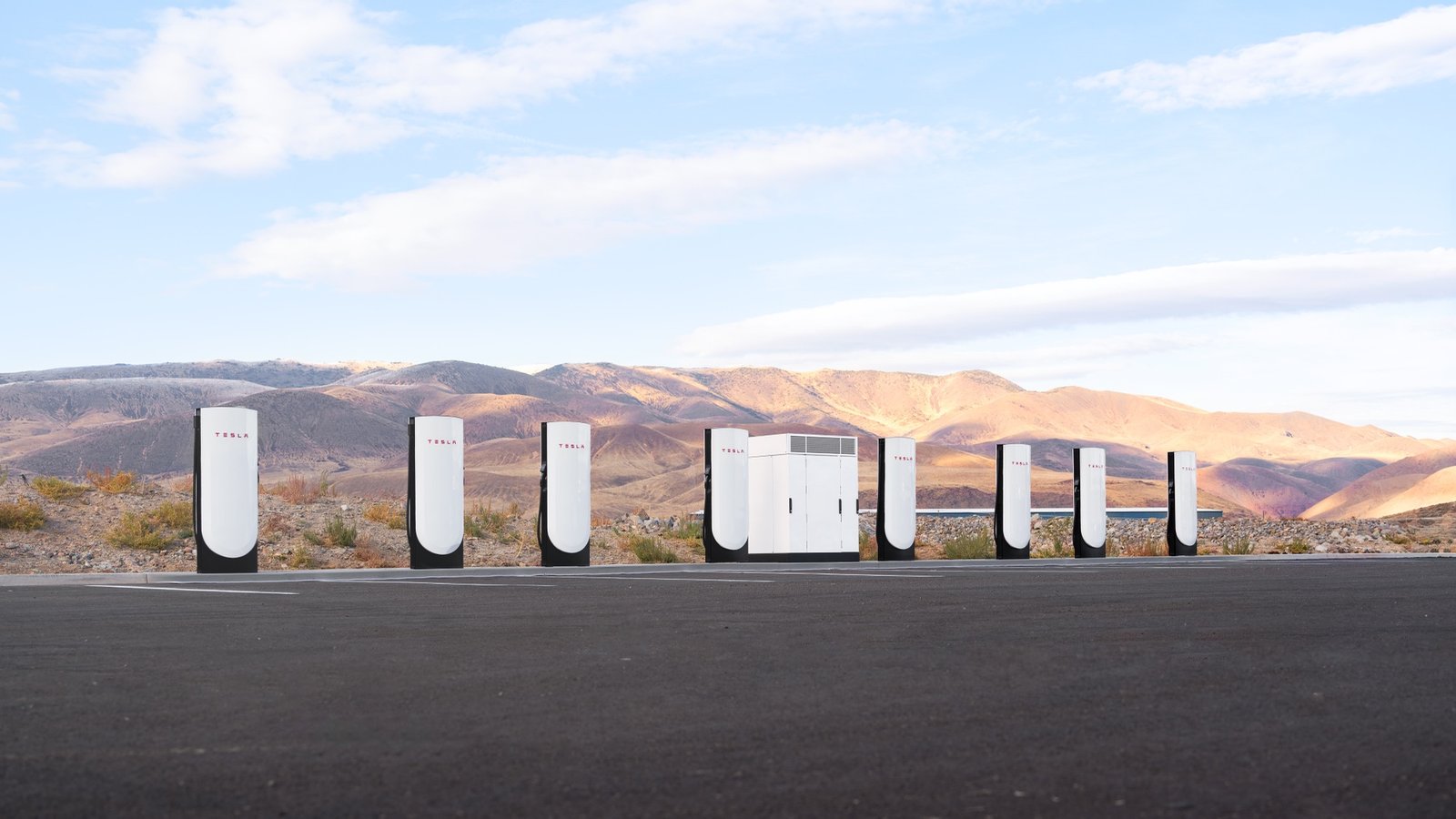
What is a Supercharger?
A Supercharger is a high-power DC fast charger, owned and operated directly by Tesla. It’s the only fast-charging network in the world run entirely by a single vehicle manufacturer, which is what makes the experience so consistent and frictionless at every station.
Superchargers can add up to 170 miles (275 km) of range in just 15 minutes. In practice, charging to 80% is enough to get back on the road, so stops stay short.
Supercharger versions: V3 and V4
Two generations of Superchargers currently coexist across Spain’s network, which is gradually being modernised toward V4.
V3 · Current generation
Supercharger V3
Up to 250 kW of power. The most widespread version on the Spanish network today. Compact design with an integrated cable.
V4 · Latest generation
Supercharger V4
Up to 250 kW. Longer cable for easier plugging in. Includes a physical payment terminal. Compatible with any electric vehicle. Expanding through 2026.
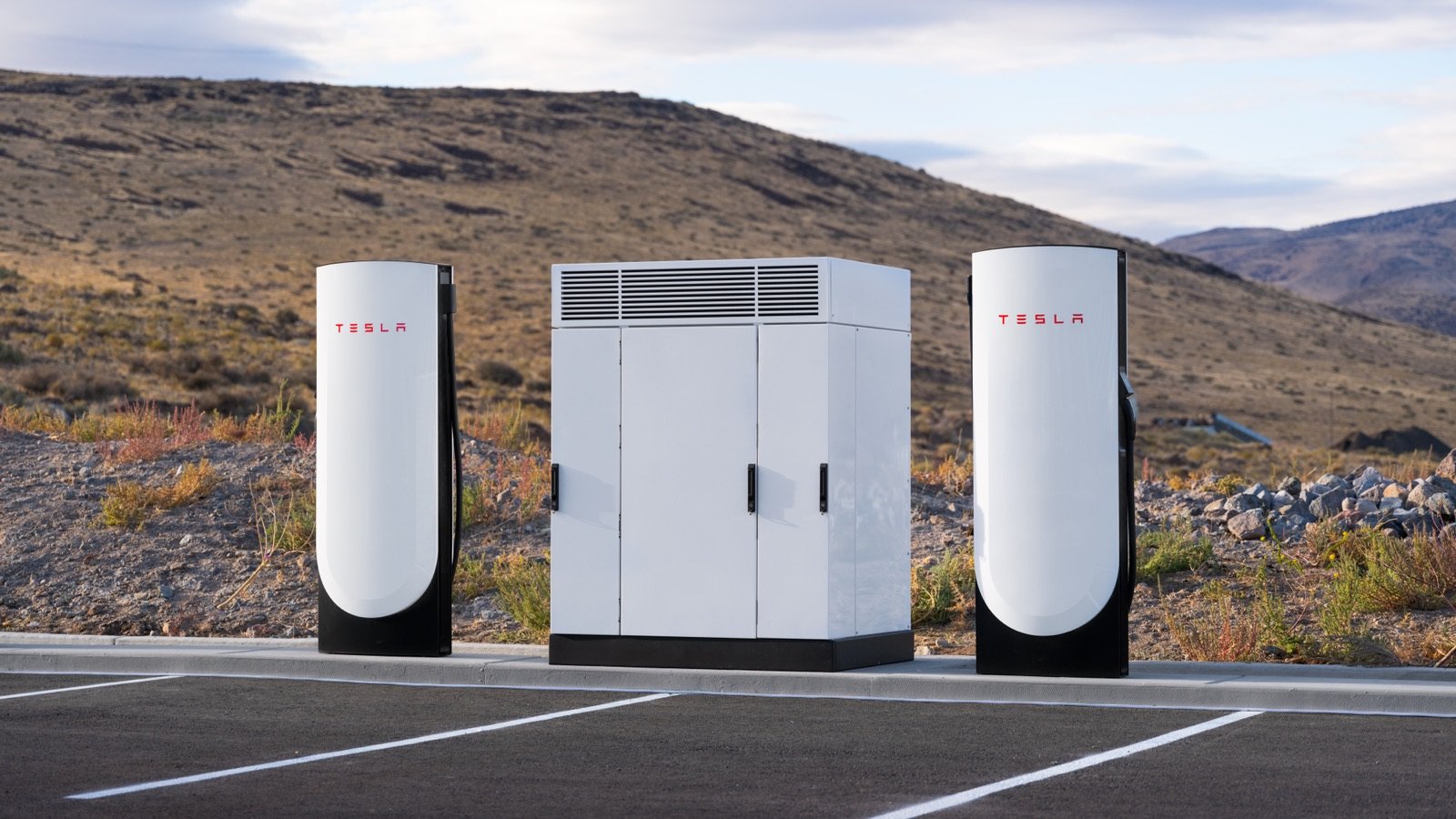
The most meaningful practical difference in V4 isn’t peak power — still 250 kW — but the internal architecture: each stall has its own dedicated power cabinet, so sharing a station with the car next to you has less effect on your charging speed than on a V3, where two neighbouring stalls do share some of the available power. The cable is also longer, designed to serve any electric vehicle, not just Teslas.
A handful of older V2 posts (up to 150 kW) are still in service at some of the network’s oldest stations in Spain, though they’re a minority and are being replaced over time.
The Tesla Diner: Tesla’s flagship station
Beyond expanding its network of ordinary posts, Tesla has started building flagship stations that combine fast charging with a restaurant and an outdoor cinema. The first opened in Hollywood, Los Angeles, in July 2025, with 80 V4 Supercharger stalls, two giant drive-in movie screens, and a retro-futuristic design that Tesla says was built using recycled Cybertruck steel.
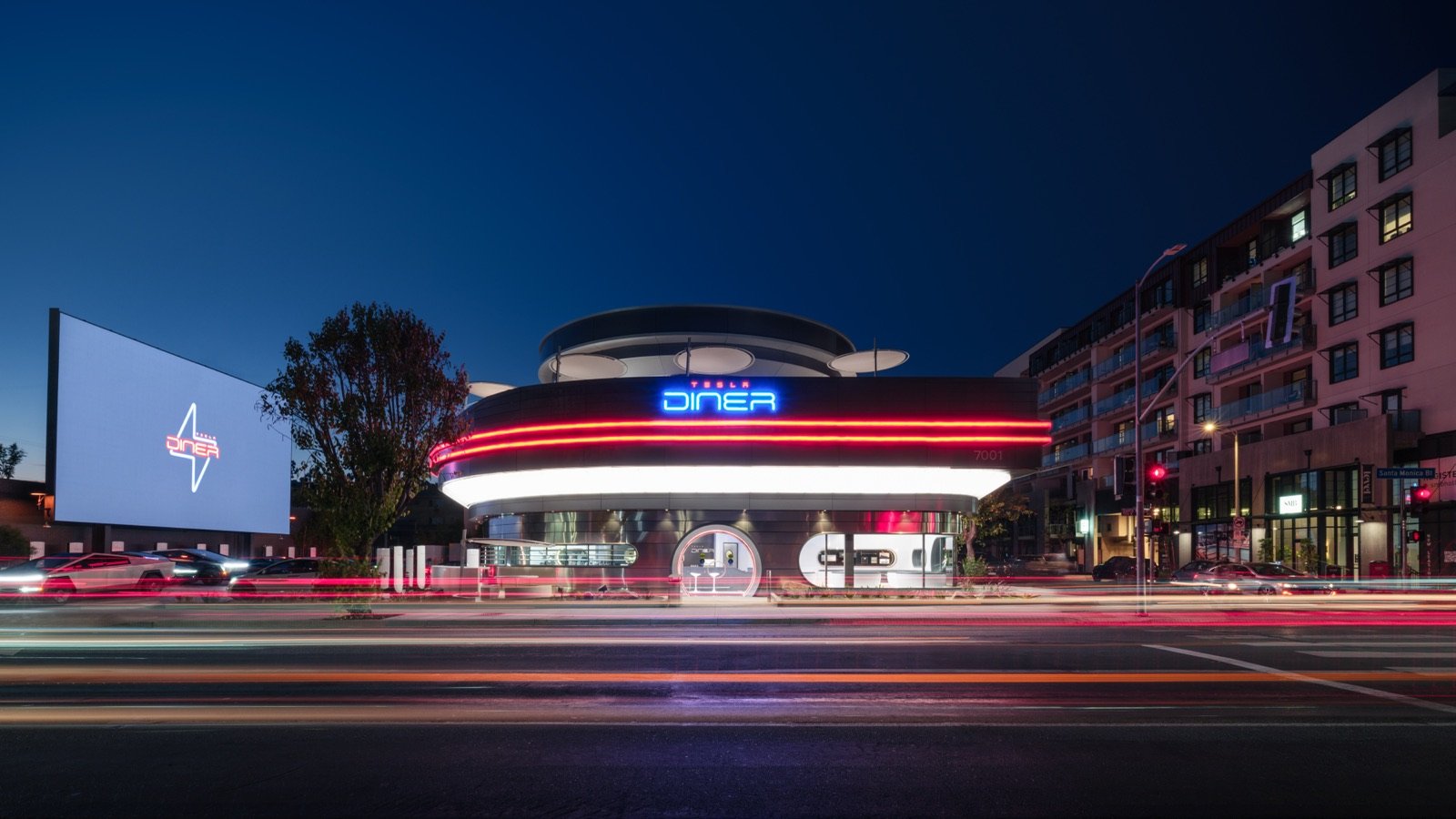
According to specialist press coverage, the Hollywood Tesla Diner has recorded up to 1,600 charging sessions a day across its 80 stalls, making it the busiest Supercharger station on the planet. Tesla has already announced a second location in Palo Alto, California.
For now this format is exclusive to the United States, with no announced plans for Spain — but it’s a good sign of where the charging-station concept is heading: from a simple energy pit stop to a destination in its own right.
↗ Source: Forbes coverage of the Tesla Diner
How much does Supercharger charging cost in Spain?
Price depends on the station, the time of day and the country — every Supercharger can carry its own rate. In Spain, indicative prices sit between €0.19 and €0.43 per kWh, cheaper overnight or when grid demand is lower.
Supercharger · off-peak
from €0.19
per kWh (indicative)
Price varies by station
Supercharger · peak hours
up to €0.43
per kWh (indicative)
Price varies by station
Home charging (night tariff)
from €0.07
per kWh
≈ €1 – 1.5 per 100 km
Equivalent petrol cost
≈ €11 – 14
per 100 km
Assuming an average price of €1.75/litre
Every Supercharger sets its own rate. Prices can vary by charge point, time of day and country. Always check the Tesla app for the exact price at a given station before you start charging.
Planning a long road trip
The car’s built-in trip planner does most of the work: enter a distant destination and it automatically works out which Superchargers to stop at and for how long, based on your battery level, expected consumption and how busy each station is.
- Enter your destination in the car’s own navigation, not your phone — that’s what triggers automatic battery preconditioning
- Let the planner choose your stops: two short stops is usually faster overall than one long one
- Check a station’s live occupancy in the app before detouring to it
- Leave some margin: arriving at 10–20% and leaving at 70–80% is the most efficient charging range
For the full breakdown of charging times by trim and charger type, see our dedicated guide: how long does it take to charge a Tesla Model 3? →
How to use a Supercharger, step by step
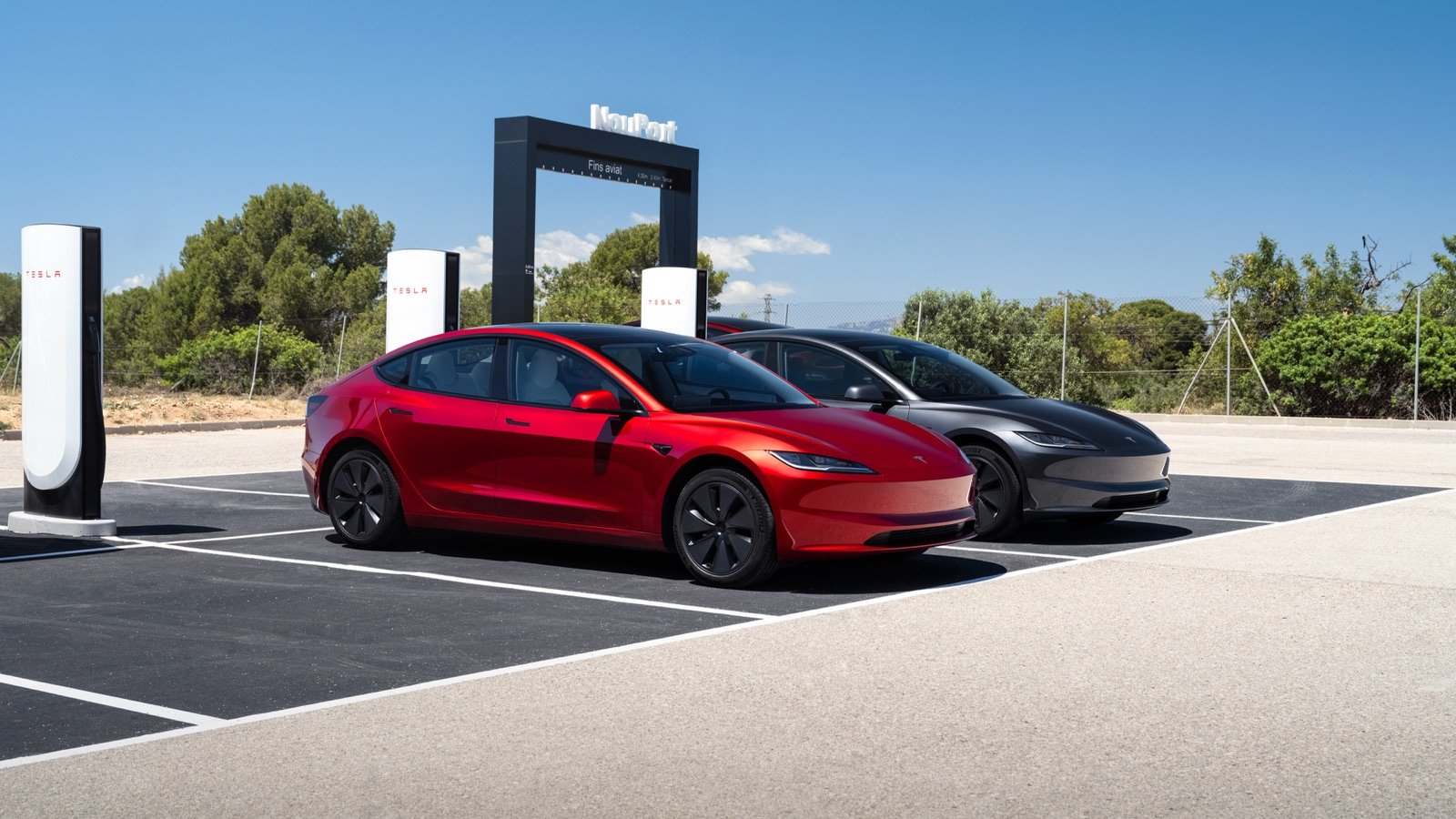
- 01Find the nearest station, or one along your route, from the car’s touchscreen or the app. The trip planner adds it automatically if you need it mid-journey.
- 02Arrive and park in one of the numbered stalls.
- 03Plug the cable into your car’s charge port. On a Tesla, charging starts automatically — no card to tap, no extra steps.
- 04Track charging progress from the app. You’ll get a notification once the car is ready to go.
- 05Unplug and continue your trip. Payment is handled automatically through the payment method linked to your Tesla account.
To keep stalls available for everyone, Tesla charges a per-minute idle fee if your car stays plugged in after it’s finished charging and the station is at 50% occupancy or higher. The app notifies you as soon as your charge is complete.
Can other brands charge there?
Since 2022 Tesla has progressively opened its network to other electric vehicles. In Spain, almost 90% of stations are now open to any brand. You’ll need the Tesla app with an account and a payment method on file.
- Download the Tesla app and create a free account
- Add a valid payment method
- Find stations open to other brands on the app’s map
- On arrival, select your stall number in the app and start the session before plugging in
Supercharger, Wall Connector or a home outlet?
The Supercharger network is built mainly for long-distance travel. For everyday use, charging at home with a Wall Connector is far more convenient and cheaper — up to four times cheaper than charging on the road.
| Option | Power | Approx. cost /100 km | When to use it |
|---|---|---|---|
| Supercharger | up to 250 kW | ≈ €5 – 11 | Long trips, fast top-ups on the road |
| Wall Connector (home) | up to 22 kW | ≈ €1 – 1.5 | Daily use, every night at home |
| Household outlet | 2.3 kW | ≈ €1 – 1.5 | Emergencies or occasional backup |
Thinking about installing a home charger? See our full guide to the Tesla Wall Connector: installation and price in Spain →
With a Wall Connector in the garage on a night tariff, cost per 100 km can drop below €1.5. Superchargers are the perfect complement for long trips, not the main source of charging.
Frequently asked questions
How long does a Supercharger session take?
Charging from 10% to 80% at a V3 or V4 Supercharger takes 20–30 minutes on a Tesla Model 3 or Model Y. A full charge can take 45–75 minutes depending on the model and battery conditions.
How much does it cost to charge a Tesla Model 3 at a Supercharger in Spain?
With a roughly 60 kWh battery and current prices, a 10–80% charge in Spain typically costs about €8–14, depending on the station and time of day.
Do I need a Tesla account to charge if I own another brand?
Yes. You’ll need to download the Tesla app, create a free account and add a payment method. V4 stalls also have a built-in physical payment terminal.
Where can I see which Supercharger stations are available?
From the touchscreen of any Tesla, from the official Tesla app, or on Tesla’s Supercharger map online. The app shows live availability for every stall.
What if I arrive and the Supercharger is full?
The app shows live availability at each station, including a forecast of free stalls around your estimated arrival time. If you’re navigating there from the car, the trip planner can automatically suggest a nearby alternative if it detects congestion.
Can I reserve a Supercharger stall?
There’s no formal reservation system. The car communicates your estimated arrival when you navigate to a Supercharger from its own screen, which helps the network manage occupancy — but it doesn’t guarantee you a free stall on arrival.
Do Superchargers work the same way across Europe?
The charging process is identical everywhere. What changes is the price per kWh, which varies by country and even between stations within the same country. If you’re charging abroad, it’s worth checking the rate in the app before you plug in.
What’s the Tesla Diner, and is there one in Spain?
It’s Tesla’s new flagship station format, combining V4 Superchargers with a restaurant and an outdoor cinema. So far it only exists in Hollywood, United States, with a second location announced in Palo Alto. There are no known plans to bring it to Spain.
Is it cheaper to charge at a Supercharger or at home?
For day-to-day use, home charging with a Wall Connector is usually cheaper and more convenient — no detour needed, and a night tariff lowers the cost per mile. Superchargers make sense on long trips, where charging speed matters more than price.